

This complete guide to running brings together everything Chicago runners need to train well and stay healthy — from running tips for beginners to strength training for runners, running form and technique, nutrition for runners, and running injury prevention. Running is simple to start but hard to sustain injury-free without the right approach. Whether you’re lacing up for the first time, coming back after a break, or deep into marathon training, most running problems trace back to a handful of factors: how you’re training, how you’re strengthening your body to support that training, and how you’re fueling and recovering along the way.
It’s organized around what RESPORT Chicago’s Old Town clinic sees North Side runners need most — including how to spot common running injuries early and when physical therapy for runners makes sense — so you can jump to what’s relevant to you now and go deeper through our full guides linked throughout.
Getting Started & Training Fundamentals
If you’re new to running, the biggest mistake isn’t bad form — it’s doing too much, too soon. A run-walk approach (alternating short running intervals with walking breaks) is the most reliable way to build a base without overwhelming tissue that isn’t used to repetitive impact yet.
Once you’re running consistently, a basic weekly structure matters more than any single workout: a mix of easy runs, one longer run, and built-in rest days. As you progress, increase your weekly mileage gradually — a common guideline is no more than about 10% per week — since sudden jumps in volume are one of the most common drivers of overuse injury.
If you’re training toward a specific distance — a 5K, half marathon, or full marathon — the general principles are the same, but the structure, mileage, and taper timing differ significantly by distance and experience level.
Before ramping up volume significantly, it’s also worth understanding your baseline running mechanics — see our Complete Guide to Running Technique Analysis for more.
Strength Training for Runners
Running alone doesn’t build the strength needed to support running. Weak hips, glutes, and core are behind many of the mechanical patterns — like hip drop or excessive vertical bounce — that we identify during running technique analyses, and building strength in these areas is one of the most effective ways to reduce injury risk and improve efficiency.
At a minimum, most runners benefit from two strength sessions per week focused on the hips, glutes, calves, and core — this doesn’t need to be complicated or time-consuming to be effective. Consistency over months matters more than intensity in any single session.
For a personalized strength program built around your training goals, our Personal Training team can help.
Running Form & Technique
Your running mechanics — cadence, foot strike, overstriding, hip stability, and more — directly influence both injury risk and efficiency. A structured technique analysis, combining video capture with a hands-on strength and mobility assessment, is the most reliable way to understand your own patterns rather than guessing.
We cover this in full depth, including what’s measured, who benefits most, and what to expect, in our Complete Guide to Running Technique Analysis.
Common Running Injuries
Most running injuries fall into a short list of usual suspects:
Shin splints — pain along the shin, often from rapid mileage increases
Plantar fasciitis — heel and arch pain, especially with the first steps in the morning
IT band syndrome — outer knee pain that worsens with continued running
Runner’s knee — pain around or behind the kneecap
Achilles tendonitis — pain and stiffness at the back of the heel
Stress fractures — a more serious overuse injury requiring rest and evaluation
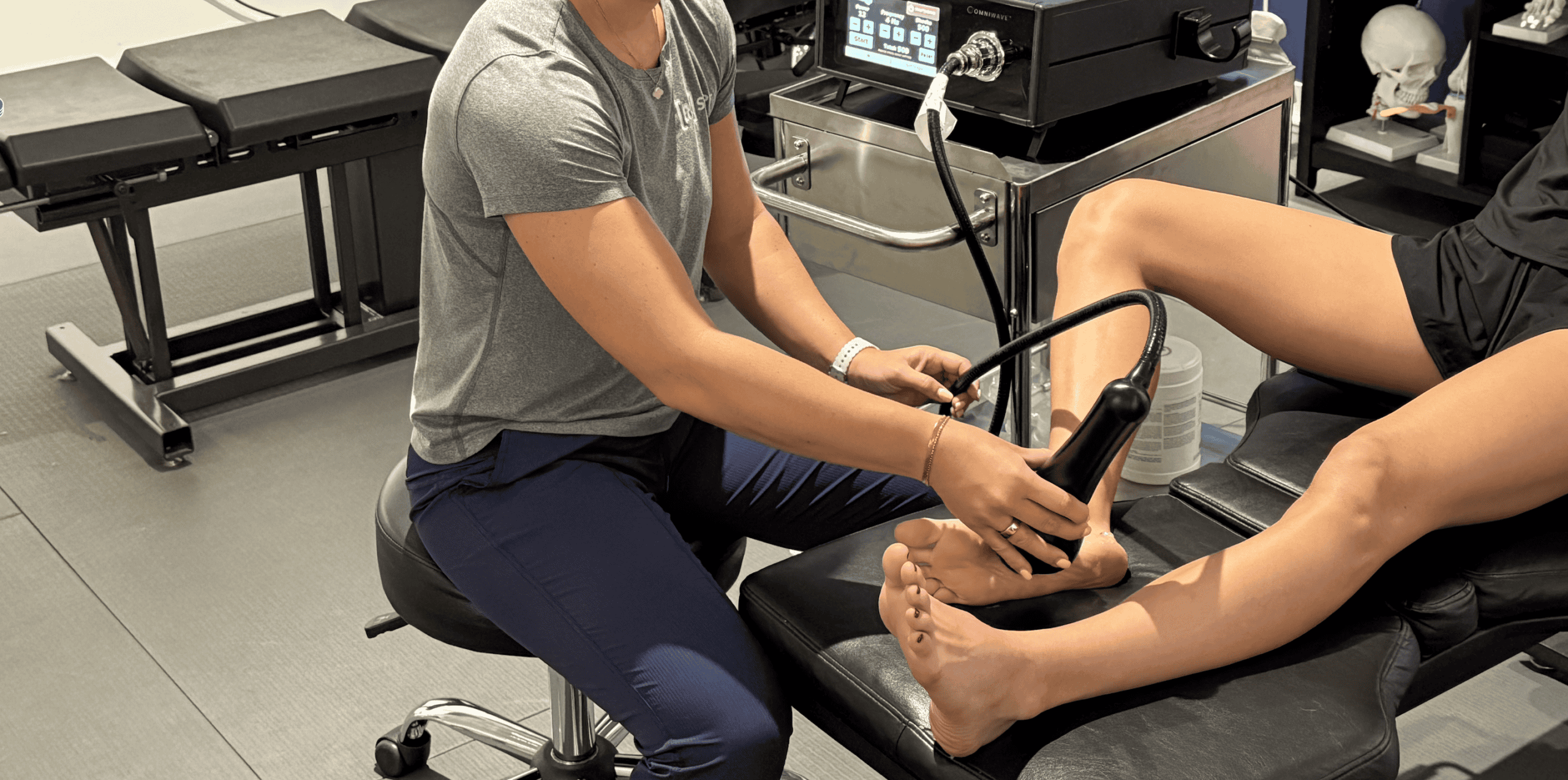
Most of these share common contributing factors: training load increases that outpace tissue adaptation, and underlying mechanical or strength deficits. For chronic cases that haven’t resolved with rest and modification, Shockwave Therapy is often an effective option.
Injury Prevention & Recovery
Prevention comes down to a few consistent habits: cross-training to reduce repetitive impact, prioritizing rest days as part of training rather than an afterthought, and paying attention to sleep and overall recovery load — not just the runs themselves.
Some soreness after a hard effort is normal; pain that persists, worsens, or changes how you’re moving is not. If something doesn’t resolve within a week or two of appropriate rest, it’s worth getting evaluated rather than pushing through it. Our Chiropractic Care, Physical Therapy, and Dry Needling services all support runners working through both acute and nagging issues.
Nutrition for Runners
What you eat affects how you run and how well you recover between runs. The basics: adequate carbohydrates to fuel training, consistent hydration (not just during runs, but throughout the day), and a mix of protein and carbohydrates after harder efforts to support recovery.
For runs under an hour, most runners don’t need to fuel mid-run. For longer efforts, especially long runs and race day, practicing your fueling strategy in training — not for the first time on race day — matters more than any specific product.
Nutrition needs vary significantly by individual and training load. Our Nutritional Counseling services can help build a plan specific to your training.
Special Situations
Certain circumstances call for extra attention before resuming or continuing training:
Postpartum runners should address the significant changes in core, pelvic floor strength, and joint laxity that occur during and after pregnancy before returning to full training.
Runners returning after a break — from injury or otherwise — often carry compensatory movement patterns that don’t automatically resolve once the original issue is gone.
Older runners may notice mechanics, strength, and recovery capacity shifting over time, which is worth accounting for rather than assuming old training habits still apply.
We cover each of these situations in more detail in our Running Technique Analysis Guide.
Gear Basics
Your shoes matter less than most runners assume, provided they’re in good condition and reasonably appropriate for your foot type and mileage — there’s no single “correct” shoe for everyone. As a general guideline, replace running shoes every 300–500 miles, or sooner if you notice new aches that coincide with worn-out cushioning.
When to See a Professional
Consider a professional evaluation if you’re dealing with persistent or recurring pain, training for a significant goal and want to train smart rather than guess, or simply want expert input on your mechanics, strength, or fueling. RESPORT Chicago supports runners across all of these areas — Running Technique Analysis, Shockwave Therapy, Personal Training, and Nutritional Counseling — in one place.
Frequently Asked Questions
How many days a week should I run as a beginner?
Most new runners do well starting with 3 days a week of running, with rest or cross-training days in between, then building frequency gradually as their body adapts.
Do I need to strength train if I only run?
Yes. Strength training, particularly for the hips, glutes, and core, addresses weaknesses that running alone doesn't build and meaningfully reduces injury risk.
What should I eat before a morning run?
For shorter runs, many runners do fine running fasted or with a small, easily digestible snack. For longer runs, a light, carbohydrate-focused snack 30–60 minutes beforehand tends to work well — though this varies by individual, so it's worth experimenting in training.
How do I know if running pain is serious?
Pain that persists beyond a few days of rest, worsens during a run, or changes how you're moving is worth having evaluated rather than managed on your own.
Understand Every Part of Your Running at RESPORT Chicago
Whether you’re building a training plan, working through an injury, or trying to fuel and recover smarter, RESPORT Chicago’s Old Town clinic supports North Side runners across training, strength, injury care, and nutrition — all in one place.
Ready to run smarter? Book an assessment at RESPORT Chicago today.
This article was medically reviewed by the RESPORT Chicago clinical team.