

Running is one of the most common kinds of exercise in the general population. Still, it’s also one of the most injury-prone — studies on recreational and competitive runners consistently find that a substantial majority will deal with at least one significant overuse injury in a given year of training. Most of these injuries follow a common thread: they develop gradually from repetitive stress outpacing the body’s ability for adaptation, rather than from a single traumatic event.
At RESPORT Chicago, we treat runners throughout Old Town and the North Side dealing with the full range of training-related injuries, and this guide walks through the most common conditions we see, what causes them, how to recognize them, and where to turn for more detailed treatment information on each.
Runner's Knee (Patellofemoral Pain Syndrome)
Patellofemoral Pain Syndrome aka Runner’s Knee, is one of the most common running injuries, causing a dull, aching pain around or behind the kneecap. This pain is typically aggravated by running, squatting, or descending stairs. It develops when the kneecap doesn’t track smoothly within its groove on the thigh bone during movement, commonly due to weakness in the hip and thigh muscles that stabilize the leg during the running stride, or from mechanical reasons like hip drop from weak hip abductors.
Common causes: Hip and quadriceps weakness, sudden increases in training volume or hill running, poor running mechanics (particularly hip instability), and worn-out running shoes.
What helps: Targeted hip and quadriceps strengthening is the primary evidence-based treatment. Managing underlying running mechanics — particularly hip drop — through a proper gait assessment is often a key piece of both treatment and prevention.
IT Band Syndrome
Iliotibial band syndrome causes sharp or burning pain on the outer side of the knee, typically worsening the longer you run and sometimes severe enough to stop a run altogether. It occurs when the IT band — a thick band of connective tissue running from the hip to just below the knee — becomes irritated from repetitive friction against the outer knee during running.
Common causes: Hip weakness (particularly the gluteus medius), sudden increases in mileage (distance or volume or both), repetitively running on sloped surfaces or tracks, and, in some cases, leg length differences.
What helps: Hip strengthening, addressing training load, surface variables, and soft tissue work can all take pressure off of the IT band and facilitate healing. Chronic and persistent cases sometimes benefit from a wider treatment approach addressing the hip mechanics driving the friction pattern in the first place.
Shin Splints (Medial Tibial Stress Syndrome)
Medial Tibial Stress Syndrome aka Shin splints, causes aching or sharp pain along the inner shin bone, typically worse during and after running. They are one of the most common injuries among runners who have recently increased mileage, intensity, or training on hard surfaces. Left untreated, chronic shin splints can progress toward a tibial stress reaction or stress fracture.
Common causes: Rapid increases in training volume, poor running mechanics (particularly overstriding), inadequate footwear, and training predominantly on hard surfaces.
What helps: For persistent cases that haven’t resolved with rest and training modification, shockwave therapy has shown favorable results for pain reduction and improved return-to-running timelines. Our full guide to shockwave therapy for shin splints covers this in more detail, including how to distinguish shin splints from a developing stress fracture — an important distinction, since the two require different management.
Achilles Tendonitis
Achilles tendonitis comes in two different types, either Insertional or Tendinous. In both, there is pain and tenderness along the Achilles tendon, typically at the back of the ankle or a few centimeters above the heel, often worse first thing in the morning and during the early part of a run before the tendon “warms up.” It’s one of the most common overuse injuries specifically tied to increases in running intensity, hill work, or speed training. Both types require similar but different types of management.
Common causes: Rapid increases in mileage or intensity, inadequate calf strength and flexibility, tight calf muscles, and, in some cases, a sudden change in foot strike pattern.
What helps: Eccentric calf-loading exercise protocols have strong research support for Achilles tendinopathy specifically. For chronic cases that haven’t responded to rest and standard rehabilitation, shockwave therapy has a well-established evidence base for both midportion and insertional Achilles tendinopathy — the latter is often associated with Haglund’s deformity, covered in our dedicated guide, since a bony prominence at the back of the heel frequently contributes to this specific pattern.
Plantar Fasciitis
Plantar fasciitis causes sharp, stabbing heel pain, classically most severe with the first steps out of bed in the morning or after periods of rest, then somewhat improving with continued movement before worsening again later in the day or after a run. It’s one of the most common running-related foot injuries and one of the most extensively studied applications of shockwave therapy specifically.
Common causes: Sudden increases in mileage, inadequate footwear or worn-out shoes, tight calf muscles, and foot mechanics including flat feet or high arches.
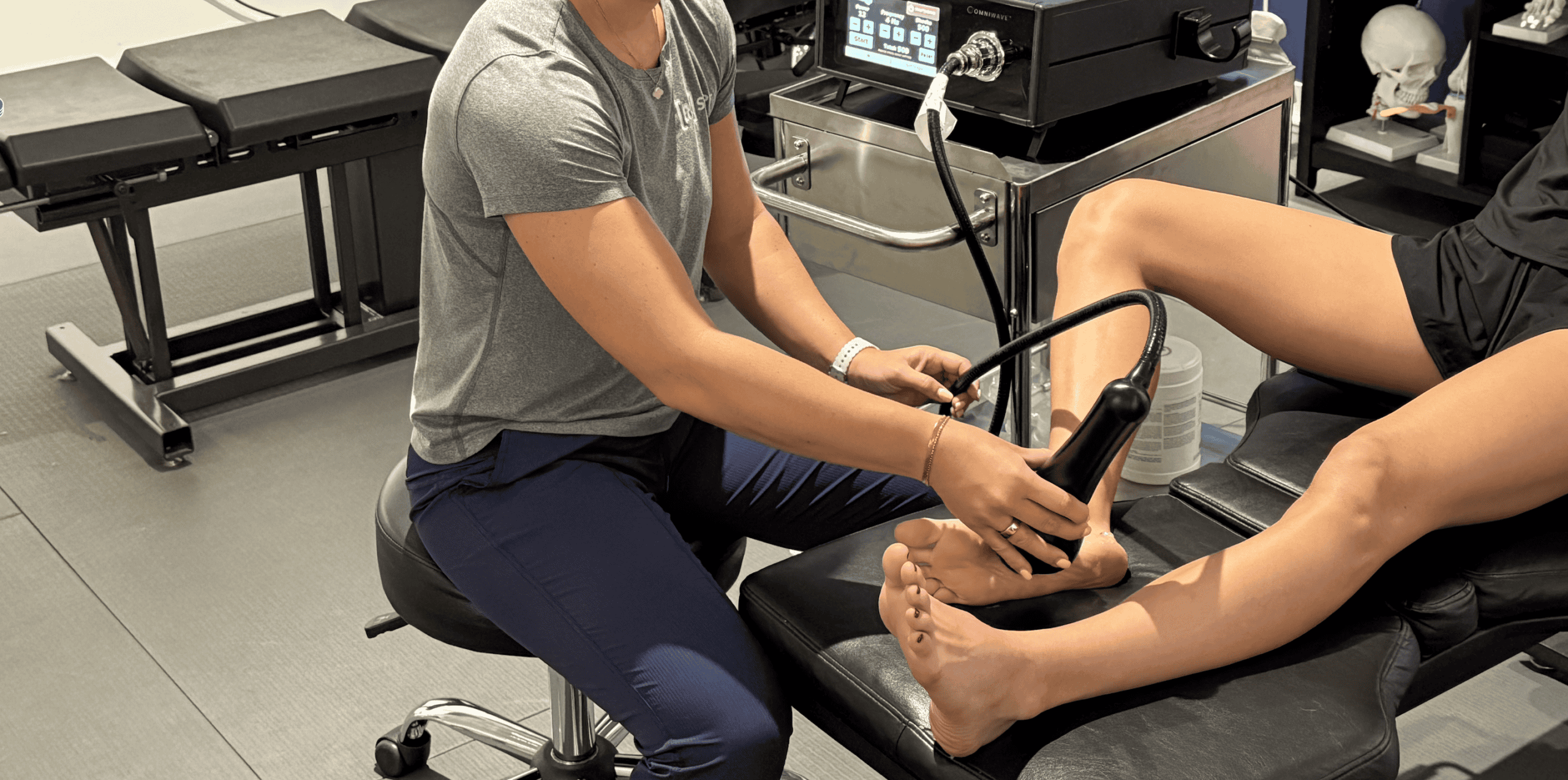
What helps: Calf and plantar fascia stretching, supportive footwear, and, for chronic cases lasting more than several months, shockwave therapy — which has some of the strongest clinical evidence of any application of the treatment, including multiple systematic reviews supporting its use for cases that haven’t responded to standard conservative care.
Stress Fractures
Stress fractures are small cracks in a bone caused by repetitive loading without adequate recovery time. They most commonly affect the shin (tibia), foot bones (metatarsals), and the hip or femur. A stress fracture is a bone injury rather than a soft tissue one, and it requires a different clinical approach, often including time off from running and an orthopedic boot or brace to adequately recover.
Common causes: Rapid increases in training volume (distance or mileage or both), incomplete recovery between hard training sessions, decreased bone mineral density (including from relative energy deficiency, sometimes seen in athletes with inadequate caloric intake relative to training demands), and training on predominantly on hard surfaces (concrete streets and sidewalks).
Warning signs: Sharp pain that’s localized to one specific point on the bone (rather than spread along a length of tissue, as with shin splints), pain that worsens with constant impact and doesn’t ease with warm-up, and pain that persists or worsens even during walking.
What helps: Stress fractures require rest from impact-loading activity and, depending on severity and location, a period of protected weight-bearing, followed by a carefully graded return to running. This is not a condition treated with shockwave therapy or other soft-tissue interventions — the priority is protecting the bone during healing, then addressing the training and biomechanical factors that contributed to the injury before returning to full training.
Hamstring Injuries (Strains and Tendinopathy)
Hamstring issues in runners generally fall into two distinct categories that are important to tell apart. An acute hamstring strain — a sudden, sharp pain typically during sprinting or a specific movement — is a different injury than proximal hamstring tendinopathy, a gradually developing, deep ache low in the glute or upper hamstring that worsens with sitting and running over time.
Common causes: Inadequate warm-up before speed work, muscle imbalances, sudden increases in sprint volume, and, for tendinopathy specifically, prolonged sitting combined with running.
What helps: Acute strains require standard phased injury management, with progressive strengthening as the tissue heals — our guide to muscle strains covers this timeline in detail, including why early-stage treatment differs from later-stage care. Chronic proximal hamstring tendinopathy, covered in our dedicated guide, commonly benefits from shockwave therapy once the condition has moved past the acute phase.
Gluteal Tendinopathy and Greater Trochanteric Pain Syndrome
This condition causes a deep ache on the outer hip. The pain is often worse with lying on the affected side at night, going up stairs, after prolonged standing, or after running. It’s frequently misdiagnosed as hip bursitis and is more common in runners than many realize, particularly among those who have increased mileage or hill training.
Common causes: Hip abductor weakness, sudden training increases, and running mechanics that place excess load on the outer hip stabilizers.
What helps: Hip strengthening and activity modification remain first-line approaches. For chronic cases, shockwave therapy has solid research support, including favorable comparisons to cortisone injection at longer-term follow-up — covered in more detail in our dedicated guide to gluteal tendinopathy.
Ankle Sprains
Even though often thought of as an acute, traumatic injury rather than an overuse condition, ankle sprains are extremely common among runners, particularly on uneven trails or during fatigue-related mechanical breakdown late in a run. A meaningful percentage of runners who sprain an ankle go on to develop chronic ankle instability or lingering pain if the injury isn’t fully rehabilitated.
Common causes: Uneven running surfaces, fatigue-related loss of proprioception and coordination late in a run, and a prior history of ankle sprains, which is one of the strongest risk factors for a repeat injury.
What helps: Joint compression, ankle strengthening, activity within pain tolerance, and other typical acute injury management initially, followed by proprioceptive and strength training to reduce recurrence risk. For lingering pain or secondary tendon issues after a sprain, our guide to ankle sprains covers when shockwave therapy becomes a relevant option.
Why So Many Running Injuries Share the Same Root Causes
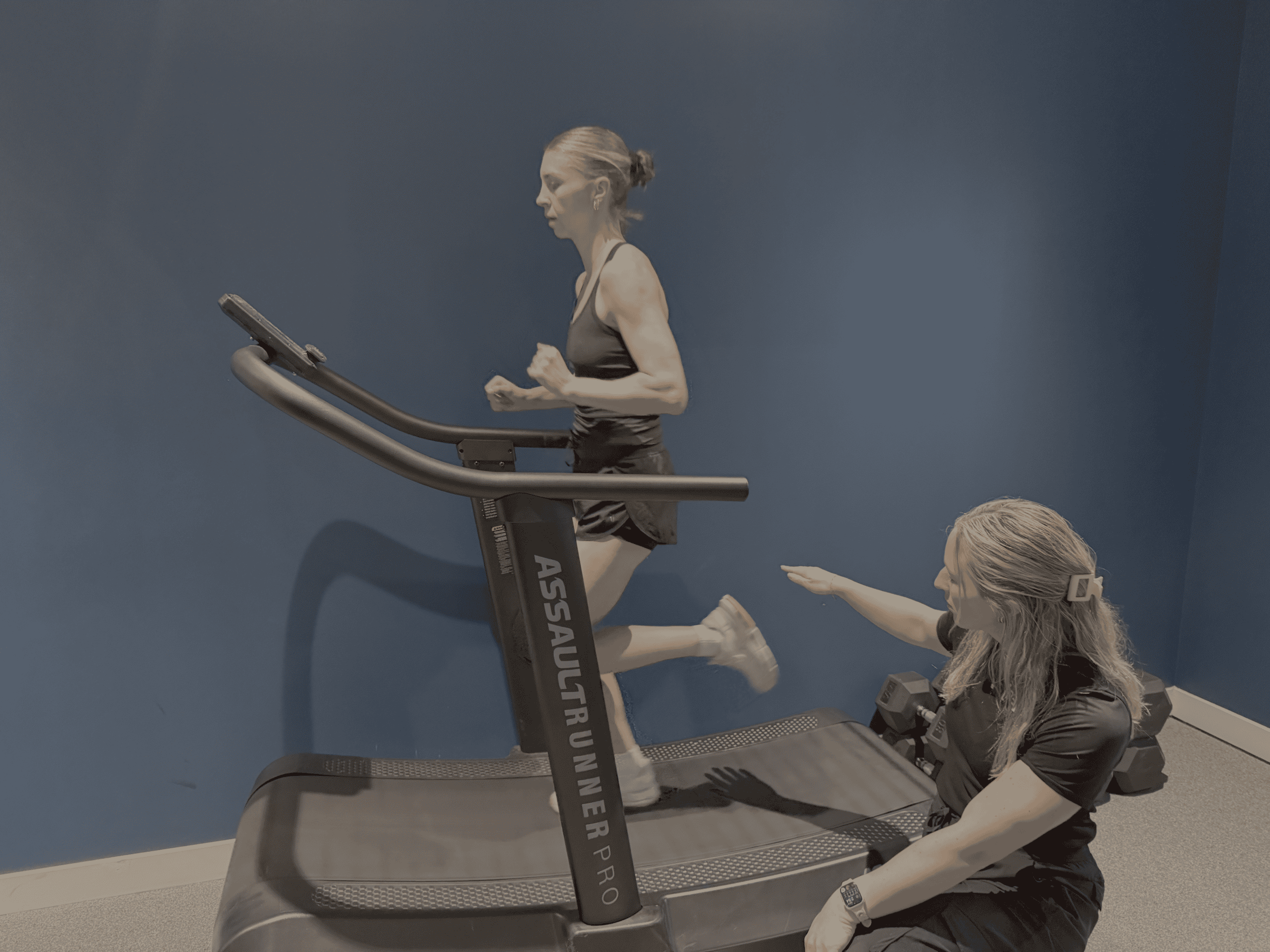
Looking across this list, a few contributing factors show up again and again: rapid increases in training volume or intensity, hip and core weakness, and running mechanics that concentrate stress on a specific structure rather than distributing it efficiently. This is exactly why addressing running mechanics and training load — not just treating each injury individually as it occurs — is such an important part of long-term injury prevention. Our companion guide on preventing injury with proper running technique covers this in more depth, including how a gait assessment can identify the specific mechanical patterns playing a role in your individual injury risk.
When to See a Provider Rather Than Self-Treating
Most mild running injuries respond quickly to a short period of decreased training volume (distance and mileage) and basic care. It is worth seeking a proper clinical evaluation if:
- Pain persists beyond 1-2 weeks of reduced activity.
- Pain is sharply localized to a specific point on a bone (raising concern for a stress fracture) rather than spread across a muscle or tendon.
- You’re modifying your gait to accommodate the pain.
- The same injury keeps recurring despite rest and return to running.
- Pain is present even at rest or significantly limits daily activity, not just running.
What to Expect at RESPORT Chicago
Whatever injury you’re dealing with, your evaluation at our Old Town clinic starts with an accurate diagnosis — distinguishing, for example, shin splints from a stress fracture, or a hamstring strain from proximal tendinopathy — since these differentiations directly determine the right treatment approach and timeline. From there, we build a plan that may include chiropractic care, targeted strength and rehabilitation exercises, gait analysis to identify contributing mechanical factors, and shockwave therapy for appropriate chronic tendon conditions.
Frequently Asked Questions
What's the most common running injury?
Runner's Knee (Patellofemoral Pain Syndrome or PFPS) is one of the most consistently reported running injuries. Other common injuries include IT band syndrome, shin splints, plantar fasciitis, and Achilles tendonitis.
How do I know if my injury is serious enough to see someone?
Pain that persists beyond one to two weeks of reduced training, pain sharply localized to a bone, or pain that's causing you to change your running form are all signs worth getting evaluated rather than continuing to push through on your own.
Can I keep running through most of these injuries?
It depends, the type and severity of your injury may allow you to manage the symptoms and continue to train. Conditions like mild tendinopathy may tolerate modified activity, while others, particularly suspected stress fractures and more chronic tendinopathies, require a full break from impact loading. This is exactly why an accurate diagnosis matters before deciding how to manage your training.
Is shockwave therapy appropriate for all of these injuries?
No. Shockwave therapy has strong evidence for chronic tendon conditions like plantar fasciitis, Achilles tendonitis, and gluteal tendinopathy. Still, it isn't appropriate for acute injuries, stress fractures, or the early phase of muscle strains and ligament sprains. The right treatment depends entirely on your specific diagnosis and where you are in the healing timeline.
How can I reduce my risk of these injuries in the first place?
Increasing training load gradually, incorporating lower extremity and core strength training, and correcting any significant biomechanical issues identified through a running gait analysis are the most well-supported strategies for lowering overall running injury risk.
Should I stop running while I recover from an injury?
It depends on the specific injury and its severity. Many of the most common injuries allow for modified or cross-training activity during recovery, while some conditions will not heal without a complete break from running. Your provider can give you specific guidance depending on your diagnosis.
Get Back to Running Pain-Free at RESPORT Chicago
Whether you’re dealing with a nagging pain that’s been slowing you down or trying to figure out why the same injury keeps coming back, an accurate diagnosis is the foundation of getting back to consistent, healthy training.
RESPORT Chicago’s Old Town clinic offers evaluation and treatment for the full range of common running injuries, combining chiropractic care, physical therapy, gait analysis, and shockwave therapy to address both your current injury and the root causes contributing to it.
Ready to find out what's behind your running injury, and how to get back on track? Book an assessment at RESPORT Chicago today.
This article was medically reviewed by the RESPORT Chicago clinical team.