

Running technique analysis has a reputation for being something only elite or competitive athletes need — a service reserved for people chasing marathon PRs, not everyday runners. That reputation isn’t accurate. If you’ve been dealing with a recurring injury, plateaued in your training, or you’re simply curious whether your form is helping or hurting you, this guide is for you.
At RESPORT Chicago, running analysis is one of the services we offer most often to runners throughout Old Town and the North Side. This guide covers what a running technique analysis actually involves, what it measures, who benefits most, and what to expect from the process — so you can figure out whether now is the right time for you.
What Is a Running Technique Analysis?
A running technique analysis — also called a gait analysis or running assessment — is a structured evaluation of how your body moves while running, designed to identify mechanical patterns that may be contributing to inefficiency, discomfort, or injury risk. Unlike simply watching someone run and offering a general impression, a proper running analysis combines objective observation (typically using video capture that can be reviewed and, in some cases, slowed down or paused) with a hands-on physical assessment of strength, flexibility, and movement patterns that influence how you run.
The goal isn’t to identify a single “correct” running form — there’s meaningful individual variation in efficient running mechanics based on your body structure, flexibility, and running history. Instead, the goal is to identify specific patterns in your mechanics that are associated with increased injury risk or reduced efficiency, so they can be addressed through targeted strength work, technique adjustments, or treatment, if needed.
What Gets Measured During a Running Analysis
A thorough running technique analysis typically evaluates several interrelated factors:
Cadence (step rate). How many steps you take per minute, which influences stride length and impact forces.
Foot strike pattern. Whether you land on your heel, midfoot, or forefoot, and — more importantly — where that landing occurs relative to your body.
Overstriding. Whether your foot is landing well ahead of your center of mass, creating a braking effect and increased impact loading with each stride.
Vertical oscillation. How much your body moves up and down with each stride, which relates to running efficiency and impact forces.
Hip and pelvic stability. Whether your pelvis remains level during the stance phase of running, or drops on one side (a pattern linked to hip weakness and associated with several common running injuries).
Knee and ankle alignment. Whether your knee tracks properly over your foot during the stride, or shows patterns like excessive inward collapse that can contribute to knee and hip injuries.
Trunk posture and lean. Your overall body position during running, including forward lean and any compensatory postural patterns.
Arm swing and upper body rotation. How your arms and trunk move during running, which can influence overall stability and efficiency.
Beyond the movement analysis itself, a complete assessment typically also evaluates strength, flexibility, and joint mobility in the hips, ankles, and core — since many of the mechanical patterns observed during running stem from underlying physical limitations rather than habits that can simply be corrected through conscious effort alone.
Why Video-Based Analysis Is More Useful Than Watching Someone Run
Running happens fast — a typical stride cycle takes well under a second — which makes it genuinely difficult for even an experienced eye to accurately assess mechanical details like foot strike timing, degree of hip drop, or precise foot strike location relative to the body just by watching in real time. Video capture allows the movement to be reviewed frame by frame, compared across multiple strides for consistency, and, in some cases, viewed from multiple angles, giving a far more accurate and objective picture than visual impression alone.
This is a meaningful distinction worth understanding when evaluating running analysis services: a genuinely useful assessment involves reviewable, objective movement capture — not just a provider watching you run on a treadmill for a minute and offering general observations.
Who Should Get a Running Technique Analysis?
A running analysis is useful for a wider range of runners than most people assume. Here's who tends to benefit most:
Runners with a current injury. Identifying whether a mechanical pattern is contributing to your injury is often an essential part of both treatment and preventing recurrence once you’re back to full training.
Runners with recurring injuries. If you keep getting the same injury, or a series of different injuries, despite following standard treatment advice, an underlying mechanical pattern is often a contributing factor worth identifying.
Runners increasing their training significantly. If you’re training for a first marathon, significantly increasing your weekly mileage, or adding speed work for the first time, understanding your mechanics beforehand can help you train more safely.
Runners returning after a break. Extended time off from running — due to injury, pregnancy, or another life circumstance — can change strength, flexibility, and movement patterns in ways worth assessing before resuming full training.
Competitive runners looking to improve efficiency. Beyond injury prevention, technique factors like excessive vertical oscillation or overstriding represent wasted energy — addressing them can contribute to improved running economy and performance.
Runners who are simply curious. You don’t need to be injured or training for a specific goal to benefit from understanding your own mechanics; many runners find it genuinely useful information for guiding their own strength training and injury prevention efforts going forward.
To be balanced: if you're running comfortably, without pain, at a stable training volume, and you're not preparing for any significant change, a technique analysis is a reasonable "nice to have" rather than an urgent need. Mechanics that are working for you don't necessarily need to be changed just because they could theoretically be optimized. That said, most runners fall into at least one of the categories above at some point — which is why this service tends to be relevant to a much wider range of runners than its "elite athlete" reputation suggests.
What to Expect During a Running Technique Analysis at RESPORT
1. Intake and History
We start by discussing your running history, current training volume, any past or current injuries, and your specific goals — whether that’s resolving a current issue, preventing a recurring one, or simply improving efficiency.
2. Strength and Mobility Assessment
Before you even step on a treadmill, we assess hip, ankle, and core strength and mobility, since limitations here frequently explain mechanical patterns observed during running — for example, hip drop during running is often directly linked to measurable hip abductor weakness identified during this portion of the assessment.
3. Video-Based Running Capture
You’ll run at your typical training pace while video is captured from multiple angles, allowing for review of cadence, foot strike, overstriding, vertical oscillation, and hip and pelvic mechanics.
4. Review and Analysis
Your provider reviews the captured footage, often frame by frame, to identify specific patterns and compare them against the strength and mobility findings from your physical assessment — connecting, for example, an observed hip drop pattern directly to a measured strength deficit, rather than treating the two as separate, unrelated findings.
5. Personalized Recommendations
Based on the complete assessment, you’ll receive a plan that may include targeted strength exercises, specific and gradually introduced technique adjustments, training load guidance, footwear considerations, and — if you’re currently dealing with an injury — an appropriate treatment plan that addresses both the injury and any contributing mechanical factors.
Curious what this actually looks like in practice? Watch a full running technique analysis with one of our patients below.
What a Running Analysis Won't Do
It’s worth being realistic about what this assessment can and can’t accomplish. A running analysis identifies patterns and contributing factors — it doesn’t guarantee injury prevention on its own, since training load, recovery, footwear, and factors outside of pure mechanics all play a role in overall injury risk. It’s also not a one-time fix: addressing an identified mechanical pattern, particularly one related to strength deficits, typically requires weeks to months of consistent targeted exercise.
Technique cues should also be introduced gradually rather than all at once. Attempting to overhaul multiple aspects of your form simultaneously — cadence, foot strike, posture — carries its own injury risk, since you’re asking your body to adapt to new movement patterns faster than tissue can typically accommodate.
How Running Analysis Connects to Injury Treatment
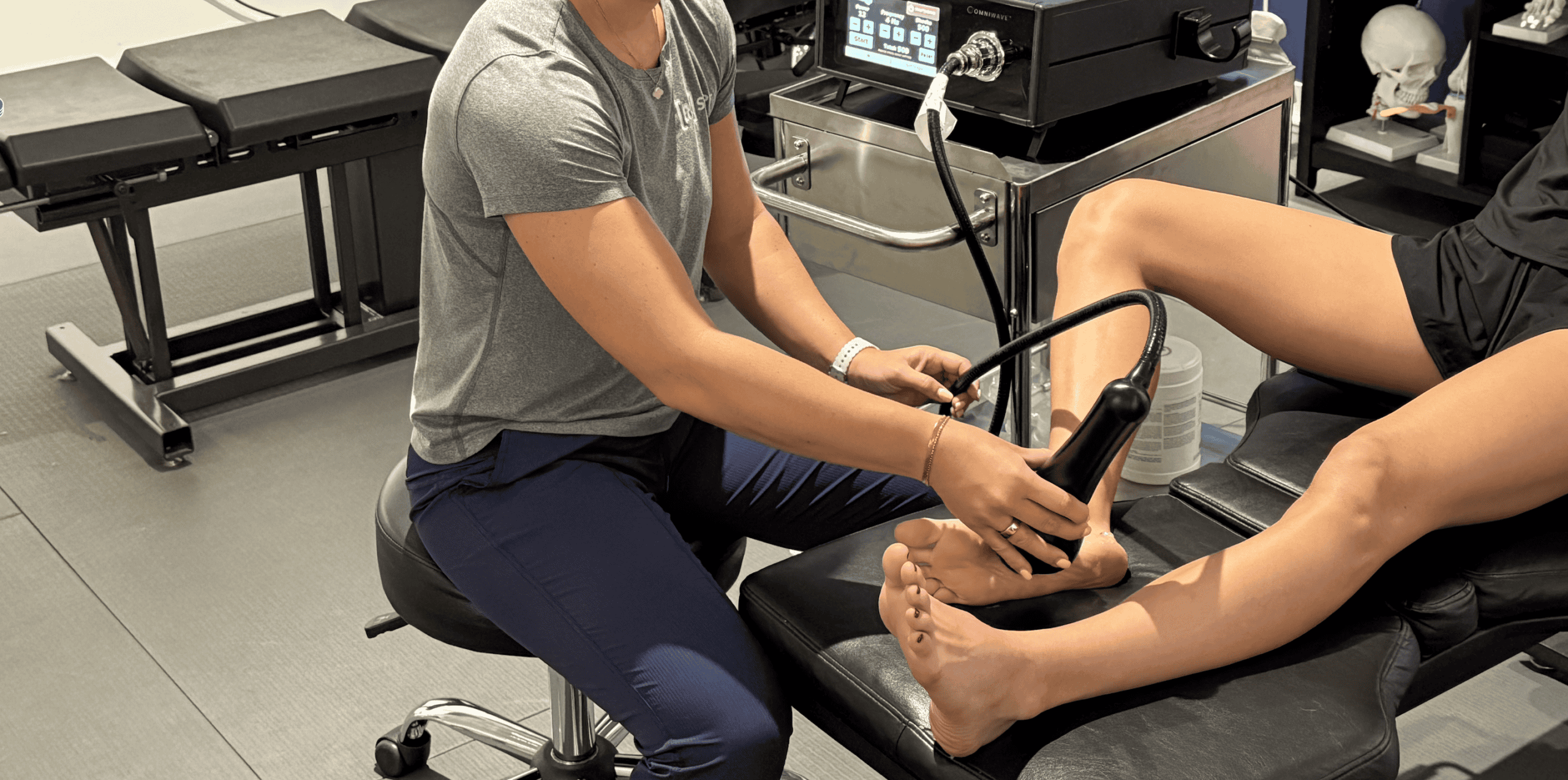
If you’re currently dealing with a running injury, a running technique analysis is often incorporated directly into your treatment plan rather than treated as a separate service. For example, a runner with chronic shin splints might have their treatment plan include both direct care — potentially including shockwave therapy for cases that haven’t resolved with rest and training modification — and gait-analysis-informed strength and mechanics work addressing the overstriding pattern that contributed to the injury in the first place. Addressing the injury without understanding the mechanical contributor behind it often means treating the same injury again down the road.
Frequently Asked Questions
How is a running technique analysis different from just watching someone run?
A proper analysis uses video capture that can be reviewed frame by frame and from multiple angles, combined with a hands-on assessment of strength and mobility — providing objective, reviewable detail that's difficult to accurately assess through real-time observation alone.
Do I need to be injured to get a running analysis?
No. While it's especially useful for runners with a current or recurring injury, many runners get an analysis proactively — before increasing training volume, returning from a break, or simply to better understand and improve their own mechanics.
Is a running technique analysis only for competitive runners?
No. Recreational runners, especially those dealing with injuries or increasing their training, often benefit just as much from understanding their mechanics as competitive athletes do.
Is a running technique analysis covered by insurance?
Coverage varies by provider and plan. Our team can help you understand your options during your initial visit.
Have more questions about what to expect? See our full Running Technique Analysis FAQ for answers on cost, injury, treadmill testing, and more.
Understand Your Running Mechanics at RESPORT Chicago
Whether you’re trying to solve a persistent injury, train for a big goal without breaking down, or simply want to understand your own running mechanics better, a proper technique analysis gives you objective, actionable information rather than guesswork.
RESPORT Chicago’s Old Town clinic offers running technique analysis combined with chiropractic care, physical therapy, and — when appropriate — shockwave therapy, giving North Side runners a complete picture of their mechanics and a clear path forward.
Ready to find out what your running mechanics look like? Book a running technique analysis at RESPORT Chicago today.
This article was medically reviewed by the RESPORT Chicago clinical team.