


What Old Town, Lincoln Park, and North Side Patients Should Know About Timing, Results, & recovery
Ankle sprains are one of the most common injuries treated in sports medicine and chiropractic care. Most heal well with standard conservative treatment. But a meaningful number of patients are left with lingering pain, instability, or stiffness long after the injury should have resolved.
If that sounds familiar, you may be wondering whether shockwave therapy for ankle sprains could help. As with muscle strains, the honest answer depends on timing and on exactly what is going on in your ankle at this stage of recovery.
At RESPORT Chicago, we treat ankle sprain patients from Old Town, River North, the Gold Coast, Lincoln Park, Lakeview, and across the Near North Side at every stage of recovery. This guide explains what an ankle sprain involves, why timing matters, where shockwave therapy has a genuine role, and when a different approach is needed.
What Is an Ankle Sprain?
An ankle sprain is an injury to one or more of the ligaments that stabilize the ankle joint. It usually happens when the ankle rolls or twists beyond its normal range of motion. That could be a misstep on an uneven sidewalk in River North, a hard cut during a pickup game in Lincoln Park, or a stumble on a run along the Lakefront Trail.
Types of Ankle Sprains
- Lateral ankle sprains are by far the most common. They involve the ligaments on the outer side of the ankle, most often the anterior talofibular ligament (ATFL) and, in more significant sprains, the calcaneofibular ligament (CFL). These typically occur when the foot rolls inward (inversion).
- Medial ankle sprains involve the deltoid ligament on the inner side of the ankle. They are less common than lateral sprains and are often linked to a more forceful injury.
- High ankle sprains (syndesmotic sprains) involve the ligaments connecting the tibia and fibula just above the ankle joint. These are frequently more severe and take longer to heal. They are more likely to need extended immobilization or, in severe cases, surgical stabilization.
Ankle Sprain Grades
- Grade I: mild stretching of the ligament fibers without significant tearing, minimal swelling, and a relatively quick recovery.
- Grade II: partial tearing of the ligament, with moderate pain, swelling, and some joint instability.
- Grade III: complete tearing of the ligament, with significant swelling, pain, joint instability, and sometimes difficulty bearing weight.
Why Timing Matters for Shockwave Therapy for Ankle Sprains
Ankle ligament tissue heals through distinct phases, and shockwave therapy is not appropriate during the earliest stage. In the days right after a sprain, the injured ligament is in an active inflammatory and early repair phase.
During that window, the standard approach is rest, ice, compression, elevation, and protected weight-bearing as tolerated. It is not the time for mechanical stimulation of healing tissue.
The real role of shockwave therapy for ankle sprains is not speeding up that initial healing. It is addressing problems that develop after a sprain has not fully resolved, which happens more often than many patients realize. Studies on ankle sprain outcomes have found that a substantial percentage of patients still have some pain, instability, or reduced function months after the injury. This pattern is sometimes called chronic ankle instability.
Where Shockwave Therapy Has a Genuine Role
Chronic Lateral Ankle Pain and Scar Tissue
When a ligament heals after a moderate-to-severe sprain, it can form scar tissue that is less organized and less elastic than the original tissue. This can contribute to ongoing stiffness, pain, and a sense of instability, even after the acute injury has technically healed. Shockwave therapy’s tissue-remodeling effect can help address this residual scar tissue, similar to its role in chronic, unresolved muscle strains.
Secondary Peroneal Tendinopathy
The peroneal tendons run along the outer ankle, right next to the most commonly sprained ligaments. It is common for these tendons to develop secondary tendinopathy after an ankle sprain. This can come from the original trauma or from compensatory overuse as the ankle stabilizes itself differently during recovery. Once it develops, it is a true tendon condition, and shockwave therapy’s well-established mechanism for tendon problems applies directly.
Chronic Ankle Impingement
After repeated or severe sprains, some patients develop impingement syndrome. Scar tissue, thickened soft tissue, or sometimes small bone spurs cause pinching pain at specific points in the ankle’s range of motion, often at the front (anterior impingement) or back (posterior impingement) of the joint. Shockwave therapy may help with the soft tissue component of impingement. Bony impingement from spurring is a structural issue that shockwave therapy does not directly resolve.
Recurrent Ankle Sprains
A prior sprain is one of the strongest risk factors for a future one. Patients with repeated sprains often have a mix of residual scar tissue, ligament laxity, and proprioceptive (balance and joint-position sense) deficits that keep the ankle vulnerable. For these patients, shockwave therapy for ankle sprains can address residual tissue changes and, combined with a proper rehabilitation program, may help reduce recurrence.
How Shockwave Therapy (ESWT) Works for Chronic Ankle Pain
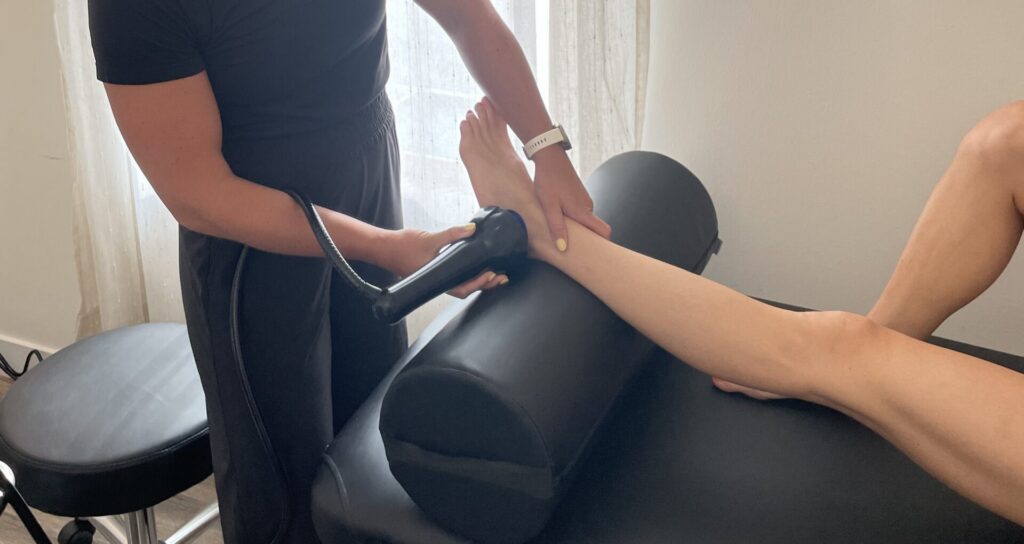
Shockwave therapy, also known as Extracorporeal Shock Wave Therapy (ESWT), delivers targeted acoustic pressure waves through a handheld applicator to the affected ligament, tendon, or soft tissue around the ankle. For chronic post-sprain issues, this shockwave treatment is thought to work by:
- Remodeling disorganized scar tissue, helping the healed ligament and surrounding soft tissue regain a more normal, functional structure.
- Stimulating blood flow to the treated area, supporting continued tissue healing. This is particularly relevant for the peroneal tendons if secondary tendinopathy has developed.
- Reducing pain sensitivity in the chronically affected area.
To be clear, shockwave therapy does not repair a torn ligament or restore normal ligament strength on its own. Ligaments are structural, elastic tissue. Significant laxity or instability from a severe tear generally requires a rehabilitation program focused on proprioceptive and strength training, bracing, or in some cases surgical stabilization for very unstable ankles. Shockwave therapy addresses the secondary soft tissue consequences of a sprain, not the torn ligament fibers themselves.
What the Research Says About Shockwave Therapy for Ankle Sprains
Research specifically on shockwave therapy for ankle sprains and their long-term effects is more limited than its extensive evidence base for conditions like plantar fasciitis. However, available research on its use for chronic ankle pain and associated peroneal tendinopathy after a sprain has generally shown favorable results for pain reduction and functional improvement.
This is a smaller, less mature research area than shockwave therapy’s classic tendon applications. Much of the clinical rationale draws on its broader, well-established evidence for tendinopathy and myofascial tissue conditions, applied to the specific anatomy and injury pattern of the ankle.
When a Different Approach Is Needed
- Suspected fracture. Not every painful, swollen ankle is a simple sprain. Bony tenderness directly over the ankle bones (the malleoli) or the midfoot, combined with an inability to bear weight, warrants imaging to rule out a fracture. This distinction, often guided by a clinical decision tool used in emergency and sports medicine, matters because a missed fracture treated as a sprain can lead to poor healing and long-term complications.
- Acute sprains within the first several weeks. This period calls for standard acute injury management, not shockwave therapy.
- Severe Grade III sprains with significant instability. These may require immobilization, bracing, or, in select cases (particularly high ankle sprains with significant instability), surgical evaluation rather than going straight to shockwave therapy.
- High ankle (syndesmotic) sprains with ongoing significant instability. These sometimes need a different management approach, including longer immobilization or surgical stabilization in severe cases. They should be evaluated by someone experienced in telling them apart from standard lateral ankle sprains.
What to Expect During an Ankle Sprain Assessment at Our Old Town Clinic
Whether your sprain is fresh or a lingering issue that never fully resolved, your evaluation at RESPORT Chicago’s Old Town clinic starts with figuring out exactly where you are in the healing process. Our location makes it easy to get in from the Gold Coast, River North, Lincoln Park, Lakeview, and the rest of the Near North Side.
1. Injury history and physical exam
We assess the mechanism, severity, and timeline of your sprain. That includes screening for signs of a fracture, syndesmotic (high ankle) involvement, or significant instability that would need prompt referral or imaging rather than standard conservative treatment.
2. Timing assessment
For recent, acute sprains, we guide you through the appropriate early-stage recovery process. If symptoms persist beyond the expected healing timeline, we reassess whether shockwave therapy for ankle sprains becomes relevant.
3. Treatment for chronic or unresolved ankle pain
For lingering post-sprain pain, secondary peroneal tendinopathy, or signs of chronic ankle instability, shockwave therapy may be part of a treatment plan alongside:
- Proprioceptive and balance training, which has strong research support for reducing recurrent ankle sprains by restoring the joint-position sense often impaired after a significant sprain.
- Progressive ankle and lower leg strengthening, particularly for the peroneal muscles that support lateral ankle stability.
- Gait and movement assessment, since compensatory movement patterns after an ankle sprain can contribute to problems elsewhere in the kinetic chain. This is especially useful for runners logging miles along the lakefront from Lincoln Park to Lakeview.
- Bracing or taping guidance for patients with ongoing instability during rehabilitation.
Frequently Asked Questions About Shockwave Therapy for Ankle Sprains
Can shockwave therapy help a fresh ankle sprain?
No, not in the acute phase. The first several weeks after an ankle sprain call for standard injury management: rest, ice, compression, elevation, and protected movement. The role of shockwave therapy for ankle sprains, when relevant, comes later, for sprains that have not fully resolved.
Can shockwave therapy repair a torn ankle ligament?
No. Shockwave therapy does not directly repair torn ligament fibers or restore ligament strength. Its role is to address secondary soft tissue issues, like scar tissue or associated tendon problems, that can develop after a sprain.
Why does my ankle still hurt months after I sprained it?
This is a common pattern. Chronic post-sprain pain often relates to residual scar tissue, secondary peroneal tendinopathy, or lingering joint instability from incomplete rehabilitation. An evaluation can help identify which factor, or combination of factors, is driving your symptoms.
How do I know if I sprained my ankle or broke it?
Bony tenderness directly over the ankle bones or midfoot, combined with an inability to bear weight, are signs that warrant an X-ray to rule out a fracture. If you are unsure, get evaluated rather than assuming it is a simple sprain.
What is a "high ankle sprain," and is it treated differently?
A high ankle sprain (syndesmotic sprain) involves the ligaments connecting the shin bones just above the ankle joint, rather than the ankle’s side ligaments. These injuries are often more severe, can take longer to heal, and sometimes require a different management approach than a standard lateral ankle sprain.
How many shockwave therapy sessions do I need for a chronic ankle issue?
Most patients undergo 4 to 6 sessions, spaced about a week apart, consistent with shockwave protocols for other chronic soft tissue conditions.
Does insurance cover shockwave therapy for ankle sprains?
No, insurance does not cover shockwave therapy. At RESPORT, we offer shockwave therapy at a per-session or package rate. Contact our team directly for current pricing — we are happy to walk you through the details.
Where can I get shockwave therapy for an ankle sprain near me in Chicago?
RESPORT provides shockwave therapy in Chicago at our Old Town clinic, serving patients from River North, the Gold Coast, Lincoln Park, Lakeview, and throughout the Near North Side.
Ankle Sprain Treatment in Old Town, Chicago: Book Your Consultation
Whether your ankle sprain is fresh or has lasted longer than it should, getting the timing and diagnosis right makes a considerable difference in your recovery. We guide you through appropriate care at every stage, from acute injury management to chronic pain that has persisted well past when it should have resolved.
Our Old Town clinic offers a thorough assessment for ankle sprains at any stage, with a treatment plan built around where you actually are in the healing process. That plan includes shockwave therapy for ankle sprains when it is the right fit. Patients from Lincoln Park, Lakeview, the Gold Coast, River North, and the Near North Side are minutes away.
Ready to find out the right next step for your ankle? Book an assessment at RESPORT Chicago today.
Questions? Contact our team — we’re happy to help you determine whether ESWT is right for your condition.
This article was medically reviewed by the RESPORT Chicago clinical team.