


RESPORT

Can Shockwave Therapy Help Arthritis? What the Research Actually Shows

July 22, 2026

If you’ve been living with arthritis pain and researching non-surgical treatment options, you’ve probably come across shockwave therapy mentioned as a potential treatment. It’s a fair question to ask — but the honest answer is slightly more complex than a simple yes or no, and it depends heavily on which type of arthritis you have and what “help” actually means in your specific case.

At RESPORT Chicago, we get this question regularly from patients in Old Town and across the North Side, and we think it’s important to give a straightforward, evidence-based answer rather than an oversimplified one. This guide covers what shockwave therapy actually does, what the current research shows about its use for arthritis specifically, where it’s genuinely useful, and where it isn’t the right tool for the job.

What Is Arthritis — And Why That Matters for Treatment

“Arthritis” is a broad term covering more than 100 different conditions that affect the joints, but the two most common types are fundamentally different, and that difference matters a great deal when evaluating any treatment, including shockwave therapy:

Osteoarthritis (OA) is a degenerative joint condition where the cartilage that cushions the ends of bones gradually wears down over time. It’s the most common form of arthritis, often related to age, joint overuse, prior injury, or mechanical wear. OA is a structural, mechanical problem.

Rheumatoid arthritis (RA) and other inflammatory or autoimmune forms of arthritis are fundamentally different — they arise when the immune system incorrectly attacks the joint lining, causing chronic inflammation and, over time, joint damage. RA is a systemic immune condition, not a mechanical wear-and-tear problem.

This distinction is essential because shockwave therapy’s mechanism of action — stimulating tissue healing and blood flow through mechanical pressure waves — is relevant to some aspects of osteoarthritis, but has no established role in treating the underlying immune process driving rheumatoid arthritis or other autoimmune joint conditions. Any discussion of shockwave therapy and arthritis is really a discussion about osteoarthritis specifically.

How Shockwave Therapy Works (And Why That's Relevant — or Not — to Arthritis)

Shockwave therapy — also known as Extracorporeal Shock Wave Therapy (ESWT) — delivers targeted acoustic pressure waves through a handheld applicator, without any incision or injection. It was originally developed and remains most established for treating chronic tendon conditions like plantar fasciitis, tennis elbow, and calcific shoulder tendonitis.

At the tissue level, shockwave therapy works by:

  1. Stimulating new blood vessel formation in tissue with poor healing capacity
  2. Triggering the body’s natural healing cascade, including growth factor release
  3. Reducing pain sensitivity in local nerve receptors
  4. Breaking down calcific deposits or disorganized tissue in some conditions


Here’s the important nuance for arthritis specifically: shockwave therapy’s core strength is stimulating healing in tendon and soft tissue that has stalled due to poor blood supply — a very different biological problem than cartilage degeneration inside a joint. Cartilage itself has essentially no blood supply at all, which is part of why joint cartilage doesn’t regenerate well on its own and why no current treatment, including shockwave therapy, can reliably regrow lost cartilage.

So Can Shockwave Therapy Help Arthritis? The Honest Answer

Shockwave therapy is not a treatment for the underlying cartilage loss in osteoarthritis, and it will not reverse or repair joint damage that has already occurred. Anyone claiming otherwise is overstating what the current evidence supports.

That said, shockwave therapy may offer meaningful benefit for arthritis patients in a few specific, more limited ways:

1. Pain Relief in Osteoarthritis

A growing body of research has specifically studied radial shockwave therapy (a lower-intensity form of shockwave therapy) as a pain management tool for knee osteoarthritis. Several studies have found meaningful reductions in pain scores and modest improvements in joint function and stiffness following a course of treatment — though these studies generally show shockwave therapy helping with symptoms rather than altering the basic structural progression of the disease. This is an important distinction: shockwave therapy in this context functions more like a pain-modulating and function-improving treatment than a disease-modifying one.

2. Treating Coexisting Tendon Problems

This is where shockwave therapy has its clearest, best-established role for arthritis patients. Many people with osteoarthritis — particularly knee and hip OA — also develop secondary tendon problems from years of altered movement patterns compensating for joint pain. A patient with knee OA might develop patellar tendinopathy from favoring the joint during activity; a patient with hip OA might develop gluteal tendinopathy from an altered gait. In these cases, shockwave therapy isn’t treating the arthritis itself, but it can very effectively treat the secondary tendon injury that’s contributing to overall pain and dysfunction — which is a well-supported, evidence-backed use of the treatment.

3. Reducing Inflammation-Related Pain

Some research suggests shockwave therapy may have a modest local anti-inflammatory effect in and around treated joints, which could contribute to symptom relief in mild-to-moderate osteoarthritis. This evidence is less robust than the research on shockwave therapy for classic tendon conditions, and results across studies have been inconsistent — some show meaningful benefit, others show more modest or short-lived effects.

What the Research Doesn't Support

To be equally clear about the limitations: current evidence does not support shockwave therapy as a treatment for:

  • Rheumatoid arthritis or other autoimmune/inflammatory arthritis — these conditions require disease-modifying treatment targeting the immune system, and shockwave therapy has no established role here.
  • Advanced or severe osteoarthritis, where cartilage loss is extensive — patients at this stage are more likely to need joint injections, bracing, or surgical options like joint replacement, and shockwave therapy is unlikely to provide meaningful relief.
  • Reversing or regenerating lost cartilage — no current non-surgical treatment reliably accomplishes this, and shockwave therapy is no exception.

If a treatment provider claims shockwave therapy will “regrow cartilage” or “cure” arthritis, that claim goes beyond what the current research supports, and it’s worth being skeptical of that framing.

Who Might Actually Benefit From Shockwave Therapy With Arthritis

Based on the current evidence, shockwave therapy is most reasonably considered for arthritis patients who fall into one of these categories:

  • Mild-to-moderate knee osteoarthritis, where the goal is pain reduction and functional improvement instead of structural reversal
  • Osteoarthritis patients who have also developed a secondary tendon injury from compensatory movement patterns — this is the clearest, best-supported use case
  • Patients looking to delay or lessen reliance on more invasive interventions, like frequent cortisone injections or surgery, as a part of a broader conservative management plan
  • Patients who haven’t gotten adequate relief from standard conservative care (physical therapy, weight management, activity modification) and want to try an additional non-invasive option before considering injections or surgery

Shockwave therapy is best thought of as one tool within a more extensive arthritis management plan — not a standalone cure, and not typically a first-line treatment ahead of physical therapy and activity modification, which remain the foundation of conservative arthritis care.

What to Expect If You Try Shockwave Therapy for Arthritis-Related Pain

If you and your provider decide shockwave therapy is worth trying — either for arthritis-related pain itself or for a secondary tendon issue related to your arthritis — here’s what the treatment typically looks like at our Old Town clinic:

1. Initial Evaluation

We start with a detailed examination of your arthritis diagnosis, imaging if available, and a physical exam to determine whether your pain is primarily coming from the joint itself, a secondary tendon issue, or both. This distinction significantly affects both the treatment plan and what results you should realistically expect.

2. Treatment Sessions

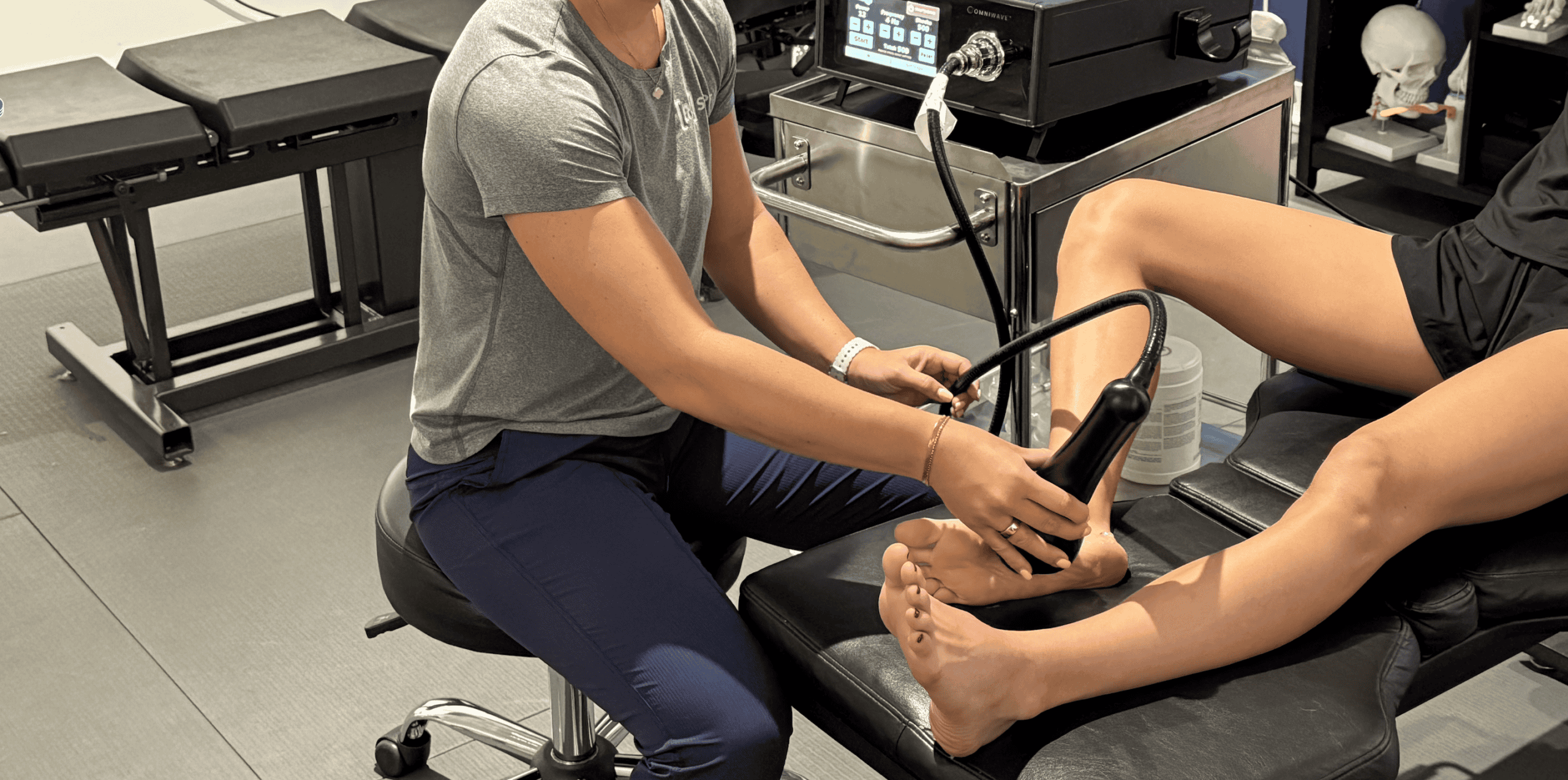
Shockwave therapy is applied over the affected area using a handheld device. Most patients describe the sensation as firm pressure or mild discomfort. Sessions generally last 10–15 minutes.

3. Treatment Course

Most patients undergo 4 to 6 sessions, spaced about a week apart, similar to shockwave protocols for tendon conditions. Results tend to build progressively across the treatment course rather than resolving after a single session.

4. A Comprehensive Approach

Because shockwave therapy isn’t a standalone arthritis treatment, we typically combine it with other elements:

  • Joint-friendly strengthening exercises to support the affected joint and reduce mechanical stress
  • Gait and movement assessment, particularly for hip and knee arthritis, to identify compensatory patterns causing secondary tendon problems
  • Chiropractic care to strengthen overall joint mechanics and reduce compensatory strain on adjacent areas
  • Activity modification guidance to balance staying active with protecting the affected joint

5. Establishing Realistic Expectations

We'll be upfront with you about what shockwave therapy can and can't do for your specific presentation. If your arthritis is advanced, or if imaging shows considerable structural joint damage, we'll discuss that honestly rather than recommending a treatment unlikely to provide meaningful benefit.

Frequently Asked Questions

Can shockwave therapy help knee arthritis?

There’s a growing body of research showing shockwave therapy can help reduce pain and improve function in mild-to-moderate knee osteoarthritis, though it works as a symptom management tool rather than reversing the underlying cartilage loss.

No. Shockwave therapy cannot regenerate lost cartilage or reverse the structural joint damage that defines osteoarthritis. However, it may help manage pain and improve function as part of a broader treatment plan.

No, shockwave therapy has no established role in treating rheumatoid arthritis or other autoimmune forms of arthritis, since these conditions require treatment targeting the underlying immune process rather than a localized mechanical stimulus.

Both have different roles. Cortisone injections can provide meaningful short-term relief for arthritis flare-ups, but don't treat any underlying tendon issues and carry some risk with repeated use. Shockwave therapy can offer more gradual and durable symptom relief, particularly when a secondary tendon problem is adding to the pain. Your specific case will determine which is more appropriate.

This depends entirely on the severity of your arthritis. Shockwave therapy is generally appropriate for mild-to-moderate cases as part of a conservative management plan, whereas severe arthritis with considerable structural damage is more likely to require surgical evaluation. An evaluation with imaging is the best way to determine where you fall on that spectrum.

Arthritis pain is often described as a deep, achy joint pain that worsens with activity and can include stiffness, especially after rest. Tendon pain tends to be more localized to a specific point around the joint and worsens predictably with certain movements. Since the two frequently coexist, a physical evaluation is the most reliable way to sort out what's actually driving your symptoms.

Shockwave therapy is typically offered as a per-session or package rate. Contact our team directly for current pricing — we are happy to walk you through the details.

Get an Honest Evaluation at RESPORT Chicago

If you’re dealing with arthritis pain and wondering whether shockwave therapy could help, the most useful next step isn’t guessing based on marketing claims — it’s getting a proper evaluation that looks at your specific diagnosis, imaging, and symptoms.

RESPORT Chicago’s Old Town clinic offers shockwave therapy as part of a comprehensive, honest approach to arthritis and joint pain management, alongside chiropractic care and physical therapy. We’ll tell you clearly whether shockwave therapy is likely to help your specific case — and if it isn’t the right fit, we’ll help you understand what is.

Ready to find out if shockwave therapy is right for your arthritis pain? Book an evaluation at RESPORT Chicago today.

Questions? Contact our team — we’re happy to help you determine whether shockwave therapy is right for your condition.

 This article was medically reviewed by the RESPORT Chicago clinical team.